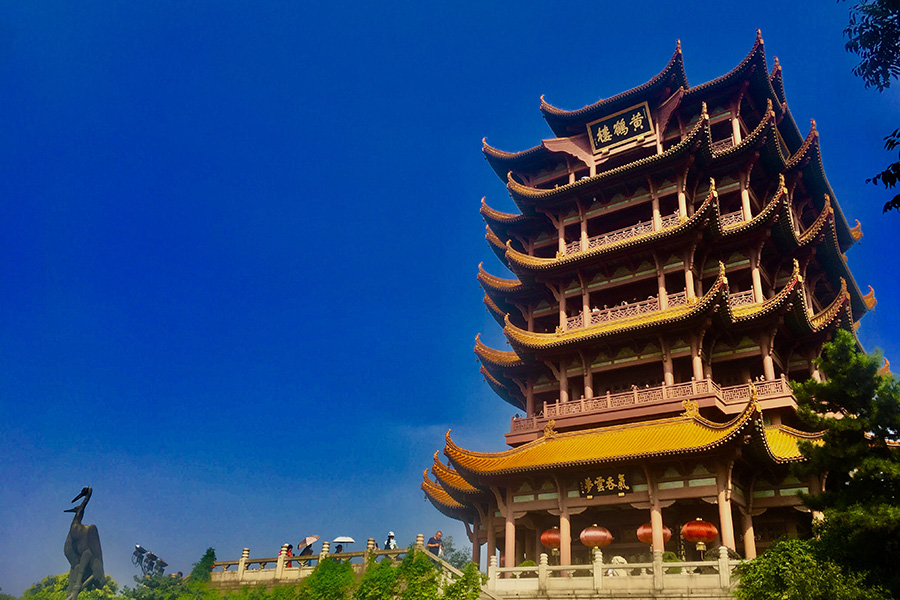
Yellow Crane Tower
Overview
Yellow Crane Tower, one of the most celebrated historical landmarks in China, is located in Wuhan, Hubei province. Known for its architectural beauty, cultural significance and historical poetry, the tower stands as a symbol of the city and a testament to its rich heritage.
The tower's architectural design is distinctive, embodying traditional Chinese aesthetics with its yellow-tiled roof and intricate eaves. It stands approximately 51.4 meters tall and offers panoramic views of the Yangtze River and the city of Wuhan. The structure is designed to reflect ancient styles while incorporating modern construction techniques to ensure durability.
The origins of Yellow Crane Tower can be traced back to the Three Kingdoms period (AD 220–280), making it more than 1,800 years old. It has been destroyed and rebuilt several times throughout history, with the current structure being a reconstruction from 1985. The tower's name is linked to various legends, including tales of an immortal riding a yellow crane, thus giving the tower its mystical aura.
Cultural Impact
Yellow Crane Tower is immortalized in the famous poem "Yellow Crane Tower" by the Tang Dynasty poet Cui Hao. The poem reflects on the themes of departure and longing, using the tower as a central motif. This literary association has cemented the tower's place in Chinese cultural history, contributing to its status as one of China's "Three Famous Towers", alongside Yueyang Tower in Hunan and Tengwang Pavilion in Jiangxi.
Yellow Crane Tower has been a muse for many artists beyond poetry. Its image is frequently depicted in visual arts, music and modern media. The tower's cultural resonance extends globally, influencing various artistic expressions, such as Belgian pianist Jean-Francois Maljean's musical compositions that incorporate the tower as a symbol of hope and unity.
Modern Influence and Renovation
Significant restoration efforts have been made to preserve the murals and aesthetics of Yellow Crane Tower. Notably, famed mural master Lou Jiaben, renowned for his dedication to the tower's murals since the 1980s, undertook restoration projects to maintain and rejuvenate the tower's artistic elements, such as the mural "Boundless River Flowing to the Sky's End".
The tower is a major tourist attraction, drawing thousands of visitors daily who come to explore its historical and cultural allure. It also serves as a cultural hub for events, like the renowned Wuhan Fashion Week, showcasing its integration into contemporary cultural expressions. Additionally, it has inspired public artworks and urban beautification projects, highlighting its ongoing influence on the city's spirit.
Yellow Crane Tower is more than just an architectural marvel; it is a cultural icon that bridges China's ancient past with its present. Its rich history, literary significance and continuous cultural relevance make it a quintessential emblem of Wuhan, illustrating the enduring power of historical monuments to inspire and connect across time. Article reference1. The Yellow Crane Tower. chinaservicesinfo.com. 20242. Looking into China’s regional culture through logos. chinadaily.com.cn. 2017Photo Gallery(3 pictures)CategoriesCultural HeritageTagHistorical BuildingCultural LandscapeRelatedYangtze River CruiseEast Lake Scenic AreaCatalogue1. Overview2. Cultural Impact3. Modern Influence and Renovation- - - []








